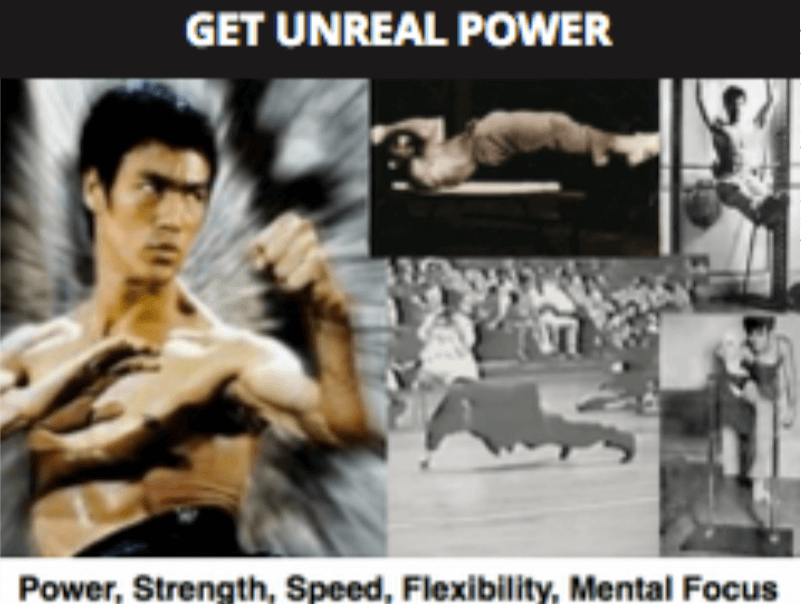
Hey Guys, if you want to get stronger fast and discover extraordinary Bruce Lee training techniques for awesome power, have a listen to the interview my buddy Ben Bergman, did with me recently. He is the owner and writer for of the PowerandMight Blog on strength training.
Below is an interview he did with me asking #10 questions that’ll give you some great cutting edge strength training techniques you can start using right away.
Our interview went for over 2 hours with a lot of great content. This video with Q&A #1 is about 15 minutes and I encourage you to check it out if you want to get stronger fast!
Here’s a video of the 1st question on his list that’ll give you great insights into what makes the CoreForce Energy training so revolutionary and why it gives you such explosive strength and speed so fast.
Discover Secrets to Bruce Lee Training for explosive power and Energy Blueprinting
👆 Press play button to gain access to an insightful interview that unveils the secrets behind Bruce Lee training secrets.
In just 15 minutes, you’ll discover a wealth of practical training ideas that can immediately enhance your strength and power. Be prepared for a deep dive into the strategies that propelled Bruce Lee to legendary status.
You’ll also see right away why Bruce Lee training and energy blueprinting created such explosive power and how it’s such a paradigm shift for how to generate extraordinary strength, speed, and endurance – and still is to this day.
In the realm of human capability, there are few things more influential and transformative than mastering breath control.
Although we often take our breathing for granted as an automatic bodily function, when we learn to consciously control it, a world of physical, mental, and emotional opportunities opens up before us. From enhancing athletic abilities and sharpening mental focus to nurturing creativity and promoting overall well-being, the practice of breath control demonstrates the profound connection between our breath, our bodies, and our minds.
The CoreForce Energy Breath Protocol training model is revolutionizing the world of fitness by significantly increasing muscular strength, endurance, and speed.
You may be wondering, what sets this type of training apart?
Breath Control: A Key Factor in Athletic Success
The answer lies in breath control. By mastering your breath, you can transform your workout routine and achieve remarkable results.
The first step is to achieve equal power during inhalation and exhalation. While this may seem simple, it is a new concept for many athletes. Traditionally, we have been taught to exhale during the exertion phase to maximize strength.
However, what if we could also harness our strength during inhalation? Breath control: a crucial factor in athletic success.
Most athletes are unaware of the way they are breathing during exercise, let alone the power of breath control and timing.
In the world of cage fighting, where ambition and determination reign supreme, fighters are constantly seeking that edge – that one secret technique that will set them apart and lead them to success.
A Game-Changing Breath Control Technique
Today, we reveal a game-changing technique that will redefine your path to greatness – a technique that revolves around the power of your breath.
Take a deep breath and let these words sink in. What if we told you that there is a specific breathing technique that can massively enhance your muscular strength, grant you unparalleled agility, and significantly boost your endurance inside the cage?
Imagine the possibilities when you can not only outlast your opponent, but also strike them precisely when they are most vulnerable, their movements slowed by fatigue. This technique is more than just a physical exercise; it is a mental and strategic advantage that can be your ultimate weapon in the cage.
Imagine the advantage of being able to throw powerful punches both on your exhale and your inhale. Your opponent would be caught off guard, finding themselves at a serious disadvantage when you continue to attack after 15 strikes on a single exhale, and then another 15 on a single inhale.
I first learned the concept of circular breathing in music school, and from there, I developed the CoreForce Energy Breath Control Protocol training model.
Trust me, maintaining a steady flow of oxygen not only enhances your speed and power, but also keeps your body’s movements fluid. Do not underestimate the power of your breath and how this breath control training technique dramatically affects your performance!
The traditional approach of performing one repetition per breath can quickly exhaust you in comparison, whether you are a fighter, a bodyweight enthusiast, a runner, or a weightlifter.
The CoreForce Energy Breath Control Protocol gives you an unfair advantage.
Imagine improving your cardiovascular endurance while running, being able to take 6-10 strides on a single exhale, and another set on your inhale, instead of the short constipated inhalations that most people do.
The moment you start applying this concept, not only does your running technique immediately change, but your elbows also pump harder with less tension in your shoulders, making you immediately more efficient. This revolutionizes the game for all athletes.
This unique breathing concept can be applied to almost everything you do. It even opens the door to a whole new way of connecting with others through touch and vocal projection.
Breath Control Mastery: The Key to Unlocking Your Full Potential
Let’s explore why mastering this unique breathing technique can be the catalyst for your success.
1. Unleashing Your Inner Strength: The core of this technique lies in the profound connection between breath and muscle power. When you learn to effectively harness your breath, you can channel that energy into your muscles, unleashing their full potential. Imagine remaining strong and explosive throughout the fight, never succumbing to fatigue. While others tire and weaken, you stand strong, ready to seize any opportunity that arises.
2. Unparalleled Agility: Agility is often the key to victory in cage fighting. The ability to move swiftly, change directions instantly, and evade your opponent’s attacks is crucial. The specialized breathing technique we are discussing can enhance your agility like never before. By maintaining precise control over your breath, you will find yourself effortlessly gliding around the cage, always in the perfect position to strike or defend.
3. Endurance Beyond Limits: Endurance is the foundation of victory in cage fighting. As your opponents start to slow down due to exhaustion, your true potential shines through. With this breathing technique, you will experience a level of endurance that others can only dream of. While your opponents lose speed, you will maintain the same lightning-fast punching speed, strategically exploiting their weaknesses.
4. The Element of Surprise: Imagine the look of shock on your opponent’s face when, in the midst of their exhaustion, you unleash a flurry of attacks with the same ferocity and precision as in the first round. That’s the power of mastering your breath. By doing so, you gain the element of surprise. Your opponents will never see your relentless assault coming, allowing you to dominate the fight when it matters most.
5. Becoming a Cage Fighting Superstar: In the world of cage fighting, it’s not just about winning matches; it’s about captivating your audience, leaving them in awe of your skill, and becoming a true superstar. When you employ this breathing technique, you become a relentless force that fans can’t take their eyes off. Your consistency in speed and power will be a spectacle, and that, my friend, is the recipe for superstardom.
Your Next Step into Mastering the Ultimate Breath Control Advantage
Now, you may be wondering how you can unlock the potential of this technique. We offer a one-on-one comprehensive coaching program that not only teaches you the technique but also guides you in mastering it. You can lean more about it by going here: the CoreForce Energy Evolution Training Rapid Mastery and Peak Performance System
The journey to becoming a top contender and a top earner in your field begins with this transformative breathing technique.
Make no mistake, this will elevate your game to unprecedented heights
The power of breath, when harnessed with precision, will be your ticket to enduring strength, unwavering agility, and an unstoppable drive to victory. Do not let this opportunity pass you by.
Are you ready to become the legend you were meant to be?
Discover many cutting-edge high-performance techniques in the CoreForce Energy coaching that will give you unstoppable muscular strength, power, speed, and endurance and propel you to a new frontier in organic movement and athleticism you never thought possible.
Have you ever wondered why athletes keep breaking records and pushing boundaries year after year?? I stumbled upon this super intriguing video featuring David Epstein that explores just that.
It seems like humans just keep getting stronger, faster, and better, but what’s causing it? Is it our genetics evolving? Is it all in our mindset? Or is it the technology we use to train and gain that competitive edge?
What’s even more fascinating is how our bodies seem to be changing to adapt to our sport and give us that edge over our competition. It’s like our bodies are evolving alongside the sports we play. It’s mind-blowing to think about!
After watching this video, I feel super inspired to keep pushing myself physically and mentally. It’s amazing to think about all the progress we’ve made and all the potential that still lies ahead. Check it out for yourself…
Enjoy!
Here’s a Transcript:
The Olympic motto is “Citius, Altius, Fortius.” Faster, Higher, Stronger. And athletes have fulfilled that motto rapidly. The winner of the 2012 Olympic Marathon ran two hours and eight minutes. Had he been racing against the winner of the 1904 Olympic marathon, he would have won by nearly an hour and a half.
Now we all have this feeling that we’re somehow just getting better as a human race, inexorably progressing, but it’s not like we’ve evolved into a new species in a century. So what’s going on here? I want to take a look at what’s really behind this march of athletic progress. In 1936, Jesse Owens held the world record in the 100 meters.
Had Jesse Owens been racing last year in the world championships of the 100 meters when Jamaican sprinter Usain Bolt finished, Owens would have still had 14 feet to go. That’s a lot in sprinter land. To give you a sense of how much it is, I want to share with you a demonstration conceived by sports scientist Ross Tucker.
Now picture the stadium last year at the world championships of the 100 meters: thousands of fans waiting with baited breath to see Usain Bolt, the fastest man in history; flashbulbs popping as the nine fastest men in the world coil themselves into their blocks. And I want you to pretend that Jesse Owens is in that race.
Now close your eyes for a second and picture the race. Bang! The gun goes off. An American sprinter jumps out to the front. Usain Bolt starts to catch him. Usain Bolt passes him, and as the runners come to the finish, you’ll hear a beep as each man crosses the line. (Beeps) That’s the entire finish of the race.
You can open your eyes now. That first beep was Usain Bolt. That last beep was Jesse Owens. Listen to it again. (Beeps) When you think of it like that, it’s not that big a difference, is it? And then consider that Usain Bolt started by propelling himself out of blocks down a specially fabricated carpet designed to allow him to travel as fast as humanly possible.
Jesse Owens, on the other hand, ran on cinders, the ash from burnt wood, and that soft surface stole far more energy from his legs as he ran. Rather than blocks, Jesse Owens had a gardening trowel that he had to use to dig holes in the cinders to start from. Biomechanical analysis of the speed of Owens’ joints shows that had been running on the same surface as Bolt, he wouldn’t have been 14 feet behind, he would have been within one stride.
Rather than the last beep, Owens would have been the second beep. Listen to it again. (Beeps) That’s the difference track surface technology has made, and it’s done it throughout the running world. Consider a longer event. In 1954, Sir Roger Bannister became the first man to run under four minutes in the mile.
Nowadays, college kids do that every year. On rare occasions, a high school kid does it. As of the end of last year, 1,314 men had run under four minutes in the mile, but like Jesse Owens, Sir Roger Bannister ran on soft cinders that stole far more energy from his legs than the synthetic tracks of today. So I consulted biomechanics experts to find out how much slower it is to run on cinders than synthetic tracks, and their consensus that it’s one and a half percent slower.
So if you apply a one-and-a-half percent slowdown conversion to every man who ran his sub-four mile on a synthetic track, this is what happens. Only 530 are left. If you look at it from that perspective, fewer than ten new men per [year] have joined the sub-four mile club since Sir Roger Bannister. Now, 530 is a lot more than one, and that’s partly because there are many more people training today and they’re training more intelligently.
Even college kids are professional in their training compared to Sir Roger Bannister, who trained for 45 minutes at a time while he ditched gynecology lectures in med school. And that guy who won the 1904 Olympic marathon in three in a half hours, that guy was drinking rat poison and brandy while he ran along the course.
That was his idea of a performance-enhancing drug. (Laughter) Clearly, athletes have gotten more savvy about performance-enhancing drugs as well, and that’s made a difference in some sports at some times, but technology has made a difference in all sports, from faster skis to lighter shoes. Take a look at the record for the 100-meter freestyle swim.
The record is always trending downward, but it’s punctuated by these steep cliffs. This first cliff, in 1956, is the introduction of the flip turn. Rather than stopping and turning around, athletes could somersault under the water and get going right away in the opposite direction. This second cliff, the introduction of gutters on the side of the pool that allows water to splash off, rather than becoming turbulence that impedes the swimmers as they race.
This final cliff the introduction of full-body and low-friction swimsuits. Throughout sports, technology has changed the face of performance. In 1972, Eddy Merckx set the record for the longest distance cycled in one hour at 30 miles, 3,774 feet. Now that record improved and improved as bicycles improved and became more aerodynamic all the way until 1996, when it was set at 35 miles, 1,531 feet, nearly five miles farther than Eddy Merckx cycled in 1972.
But then in 2000, the International Cycling Union decreed that anyone who wanted to hold that record had to do so with essentially the same equipment that Eddy Merckx used in 1972. Where does the record stand today? 30 miles, 4,657 feet, a grand total of 883 feet farther than Eddy Merckx cycled more than four decades ago.
Essentially the entire improvement in this record was due to technology. Still, technology isn’t the only thing pushing athletes forward. While, indeed we haven’t evolved into a new species in a century, the gene pool within competitive sports most certainly has changed. In the early half of the 20th century, physical education instructors and coaches had the idea that the average body type was the best for all athletic endeavors: medium height, medium weight, no matter the sport.
And this showed in athletes’ bodies. In the 1920s, the average elite high-jumper and average elite shot-putter were the same exact size. But as that idea started to fade away, as sports scientists and coaches realized that rather than the average body type, you want highly specialized bodies that fit into certain athletic niches, a form of artificial selection took place, a self-sorting for bodies that fit certain sports, and athletes’ bodies became more different from one another.
Today, rather than the same size as the average elite high jumper, the average elite shot-putter is two and a half inches taller and 130 pounds heavier. And this happened throughout the sports world. In fact, if you plot on a height versus mass graph one data point for each of two dozen sports in the first half of the 20th century, it looks like this.
There’s some dispersal, but it’s kind of grouped around that average body type. Then that idea started to go away, and at the same time, digital technology — first radio, then television and the Internet — gave millions, or in some cases billions, of people a ticket to consume elite sports performance.
The financial incentives and fame and glory afforded elite athletes skyrocketed, and it tipped toward the tiny upper echelon of performance. It accelerated the artificial selection for specialized bodies. And if you plot a data point for these same two dozen sports today, it looks like this. The athletes’ bodies have gotten much more different from one another.
And because this chart looks like the charts that show the expanding universe, with the galaxies flying away from one another, the scientists who discovered it call it “The Big Bang of Body Types.” In sports where height is prized, like basketball, the tall athletes got taller. In 1983, the National Basketball Association signed a groundbreaking agreement making players partners in the league entitled to shares of ticket revenues and television contracts.
Suddenly, anybody who could be an NBA player wanted to be, and teams started scouring the globe for the bodies that could help them win championships. Almost overnight, the proportion of men in the NBA who are at least seven feet tall doubled to 10 percent. Today, one in 10 men in the NBA is at least seven feet tall, but a seven-foot-tall man is incredibly rare in the general population — so rare that if you know an American man between the ages of 20 and 40 who is at least seven feet tall, there’s a 17 percent chance
he’s in the NBA right now. (Laughter) That is, find six honest seven-footers, one is in the NBA right now. And that’s not the only way that NBA players’ bodies are unique. This is Leonardo da Vinci’s “Vitruvian Man,” the ideal proportions, with an arm span equal to height. My arm span is exactly equal to my height.
Yours is probably very nearly so. But not the average NBA player. The average NBA player is a shade under 6’7″, with arms that are seven feet long. Not only are NBA players ridiculously tall, they are ludicrously long. Had Leonardo wanted to draw the Vitruvian NBA Player, he would have needed a rectangle and an ellipse, not a circle and a square.
So in sports where large size is prized, the large athletes have gotten larger. Conversely, in sports where diminutive stature is an advantage, the small athletes got smaller. The average elite female gymnast shrunk from 5’3″ to 4’9″ on average over the last 30 years, all the better for their power-to-weight ratio and for spinning in the air.
And while the large got larger and the small got smaller, the weird got weirder. The average length of the forearm of a water polo player in relation to their total arm got longer, all the better for a forceful throwing whip. And as the large got larger, small got smaller, and the weird weirder. In swimming, the ideal body type is a long torso and short legs.
It’s like the long hull of a canoe for speed over the water. And the opposite is advantageous in running. You want long legs and a short torso. And this shows in athletes’ bodies today. Here you see Michael Phelps, the greatest swimmer in history, standing next to Hicham El Guerrouj, the world record holder in the mile.
These men are seven inches different in height, but because of the body types advantaged in their sports, they wear the same length pants. Seven inches difference in height, these men have the same length legs. Now in some cases, the search for bodies that could push athletic performance forward ended up introducing into the competitive world populations of people that weren’t previously competing at all, like Kenyan distance runners.
We think of Kenyans as being great marathoners. Kenyans think of the Kalenjin tribe as being great marathoners. The Kalenjin make up just 12 percent of the Kenyan population but the vast majority of elite runners. And they happen, on average, to have a certain unique physiology: legs that are very long and very thin at their extremity, and this is because they have their ancestry at very low latitude in a very hot and dry climate, and an evolutionary adaptation to that is limbs that are very long and very thin at the extremity for cooling purposes. It’s the same reason that a radiator has long coils, to increase surface area compared to volume to let heat out, and because the leg is like a pendulum, the longer and thinner it is at the extremity, the more energy-efficient it is to swing. To put Kalenjin running success in perspective, consider that 17 American men in history have run faster than two hours and 10 minutes in the marathon.
That’s a four-minute-and-58-second-per-mile pace. Thirty-two Kalenjin men did that last October. (Laughter) That’s from a source population the size of metropolitan Atlanta. Still, even changing technology and the changing gene pool in sports don’t account for all of the changes in performance. Athletes have a different mindset than they once did.
Have you ever seen in a movie when someone gets an electrical shock and they’re thrown across a room? There’s no explosion there. What’s happening when that happens is that the electrical impulse is causing all their muscle fibers to twitch at once, and they’re throwing themselves across the room.
They’re essentially jumping. That’s the power that’s contained in the human body. But normally we can’t access nearly all of it. Our brain acts as a limiter, preventing us from accessing all of our physical resources, because we might hurt ourselves, tearing tendons or ligaments. But the more we learn about how that limiter functions, the more we learn how we can push it back just a bit, in some cases by convincing the brain that the body won’t be in mortal danger by pushing harder.
Endurance and ultra-endurance sports serve as a great example. Ultra-endurance was once thought to be harmful to human health, but now we realize that we have all these traits that are perfect for ultra-endurance: no body fur and a glut of sweat glands that keep us cool while running; narrow waists and long legs compared to our frames; large surface area of joints for shock absorption.
We have an arch in our foot that acts like a spring, short toes that are better for pushing off than for grasping tree limbs, and when we run, we can turn our torso and our shoulders like this while keeping our heads straight. Our primate cousins can’t do that. They have to run like this. And we have big old butt muscles that keep us upright while running.
Have you ever looked at an ape’s butt? They have no buns because they don’t run upright. And as athletes have realized that we’re perfectly suited for ultra-endurance, they’ve taken on feats that would have been unthinkable before, athletes like Spanish endurance racer Kílian Jornet. Here’s Kílian running up the Matterhorn.
(Laughter) With a sweatshirt there tied around his waist. It’s so steep he can’t even run here. He’s pulling up on a rope. This is a vertical ascent of more than 8,000 feet, and Kílian went up and down in under three hours. Amazing. And talented though he is, Kílian is not a physiological freak. Now that he has done this, other athletes will follow, just as other athletes followed after Sir Roger Bannister ran under four minutes in the mile.
Changing technology, changing genes, and a changing mindset. Innovation in sports, whether that’s new track surfaces or new swimming techniques, the democratization of sport, the spread to new bodies and to new populations around the world, and imagination in sport, an understanding of what the human body is truly capable of, have conspired to make athletes stronger, faster, bolder, and better than ever.
You will be able to recover more quickly and become stronger with a good?stretch workout.It is a common myth that stretching out before a workout will keep you from hurting yourself, but it turns out that the opposite is true.
Researchers from the University of Hawaii-Moana studied over a thousand marathon runners. Results of this study revealed that stretching prior to a workout increased chances of sustaining injury. Runners who waited to stretch until after the marathon were just fine, but those who stretched before the marathon increased their risk of injury by 33%.
Stretching your muscles causes them to loosen and it removes tension on the joints, it also puts your muscle into a relaxed and resting state. After stretching, muscles are stretched out and this can be very dangerous.
Muscles need to contract over and over during exercise, and when they are stretched out they need to work much harder to contract effectively.
Warm up your body by moving, not stretching before strenuous exercise, then do the?stretch workout after you are done. Stretching afterwards enhances recovery and increases the body”s ability to travel through its range of motion. ?Stretching after your workout will help your muscles recover faster. Another benefit is that you will gain more strength this way than if you stretch beforehand. You can increase strength gains by as much as ten percent.
The muscles contract during exercise, which is a valid point that deserves being repeated here. ?Your muscles will stay in contraction for the first few hours following a weight lifting session. Until your muscles will not have recovered until they have returned to their original length instead of the contracted length.
By stretching out after a workout, the muscles get to recover much faster. Do a stretch workout right after your resistance training for the best effect. Static and Dynamic are the two types of stretches, do the right kind of?stretch workout. Static stretching is the best to boost muscle recovery after an intense workout and increase strength. When it comes to stretching, this is the most accessible technique. ?All you need to do is hold the stretch for 30 seconds to a minute. Be sure to take nice deep breaths and relax, stretching feels good.
MMA strength training In the dynamic world of combat sports is essential to fully understand the various elements that one should concentrate on to gain the ultimate advantage in the cage.
In combat, whether it be in combat sports or self-defense in the street, the prowess to unleash devastating punches from any stance is a transformative game-changer that can redefine the outcome of a fight. Imagine a fighter not only armed with the strength to deliver impactful blows but also possessing the capability to maintain that strength even when thrown off balance.
These attributes present a significant advantage, and comprehending the subtleties of strength endurance, muscle endurance, and their pivotal roles in achieving optimal cardiovascular advantage through concurrent and strategic strength training is paramount.
The Impact of Enhanced Striking in MMA Strength Training:
At the heart of a formidable fighter’s arsenal is the ability to punch with unparalleled force. The benefits of enhanced striking extend far and wide, profoundly influencing the dynamics of a match. Equipping a fighter with the skill to deliver harder punches not only elevates their offensive capabilities but also creates opportunities to control critical moments and dictate the pace of the fight.
Consistent Strength from Any Position in MMA Strength Training:
One of the most distinctive advantages a fighter can possess is the capacity to maintain consistent strength regardless of their body’s orientation. This capability reinforces defensive strategies and amplifies offensive maneuvers. Envision yourself as a fighter being able to seamlessly adapt to unpredictable situations, countering attacks with unwavering strength from every conceivable angle. This adaptability not only confuses opponents but also instills a sense of confidence and control in the fighter.
Strength Endurance vs. Muscle Endurance in MMA Strength Training:
To grasp the intricacies of optimal performance, it is crucial to differentiate between strength endurance and muscle endurance. Strength endurance involves the ability to consistently exert force over extended periods, contributing to sustained power throughout a match. Conversely, muscle endurance focuses on the localized stamina of specific muscle groups, ensuring they can endure the demands of intense combat.
The Significance of Optimal Cardio Advantage in MMA Strength Training:
Cardiovascular fitness stands as a cornerstone of a fighter’s endurance and overall performance. Attaining optimal cardio advantage involves refining the cardiovascular system to efficiently deliver oxygen to working muscles, delaying fatigue, and sustaining peak performance throughout the duration of a bout. By integrating strength endurance and muscle endurance into strength training protocols, fighters can enhance their cardiovascular capacity, gaining a crucial edge in the unforgiving arena of combat sports.
Strategic Strength Training for Unrivaled Performance:
Achieving the outlined benefits demands a meticulous approach to MMA strength training. Designing a regimen that seamlessly integrates strength and muscle endurance, alongside focused cardiovascular conditioning, is paramount. Strategic training not only refines a fighter’s physical attributes but also sharpens their mental acuity, fostering a holistic approach to combat.
Mastering MMA strength training is about empowering a fighter with the ability to deliver more powerful punches and maintain consistent strength from any angle. Understanding the nuances of strength endurance, muscle endurance, and optimal cardio advantage allows fighters to elevate their performance to unprecedented levels. Armed with these insights, trainers and fighters alike can embark on a disciplined training journey, sculpting warriors capable of facing any challenge in the relentless pursuit of victory.
The Next Step in Your MMA Strength Training Evolution
Now that you’ve delved into the pivotal role of enhanced striking in combat sports, it’s time to take your knowledge to the next level. Discover the Quantum Human Activation System and CoreForce Energy Evolution Training one-on-one elite coaching and online training. Here, you’ll learn step-by-step how to elevate your performance and dominate the arena with unrivaled strength and strategic training.